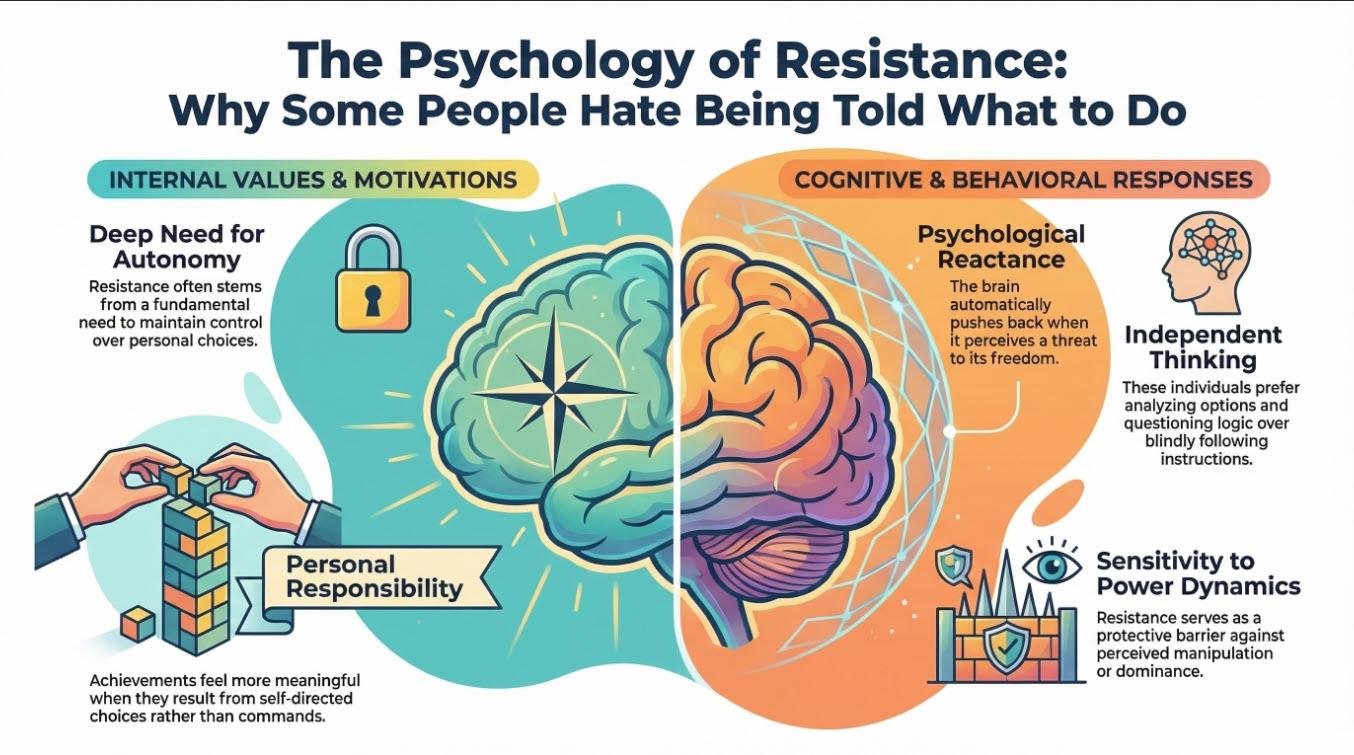
This article explores the psychology of resistance behind individuals who resist authority and dislike being directed by others.
Rather than simple stubbornness, this behavior often stems from a deep-seated need for autonomy and a natural phenomenon called psychological reactance. Such individuals tend to be independent thinkers who prioritize personal responsibility and prefer to reach their own conclusions through careful analysis.
They are also highly sensitive to power dynamics, viewing even minor commands as potential threats to their personal boundaries. Ultimately, the text suggests that this defiance is a mechanism for maintaining control over one’s life and ensuring that achievements feel personally meaningful.
This perspective shifts the narrative from viewing resistance as a negative trait to seeing it as a sign of a self-directed mind.
Independent thinkers often struggle with direct orders because of several key psychological traits that prioritize self-direction over external control.
- A Strong Need for Autonomy: These individuals have a deep-seated requirement to feel in control of their own decisions. When they receive a direct order, it threatens their sense of independence, causing an internal pushback to maintain control over their choices.
- Psychological Reactance: This is a natural brain response that occurs when a person feels their freedom is being restricted. When told they “have to” do something, their mind automatically pushes back to restore that perceived lost freedom, often resulting in an immediate desire to do the opposite.
- The Desire for Self-Directed Analysis: Independent thinkers prefer forming their own conclusions rather than blindly following instructions. They tend to ask questions, evaluate options, and analyze situations themselves, which can be perceived as resistance by others.
- Personal Responsibility and Ownership: These individuals highly value ownership over their own lives and achievements. They want to succeed because they chose to, not because they were told to, as personal choice makes the outcome feel more meaningful.
- Sensitivity to Power Dynamics: They are often very aware of when someone is trying to dominate, manipulate, or control them. Because of this sensitivity, even small commands can feel like a form of pressure, leading them to resist as a way of protecting their personal boundaries.
If you want assistance with this article, please Contact Us